Overview
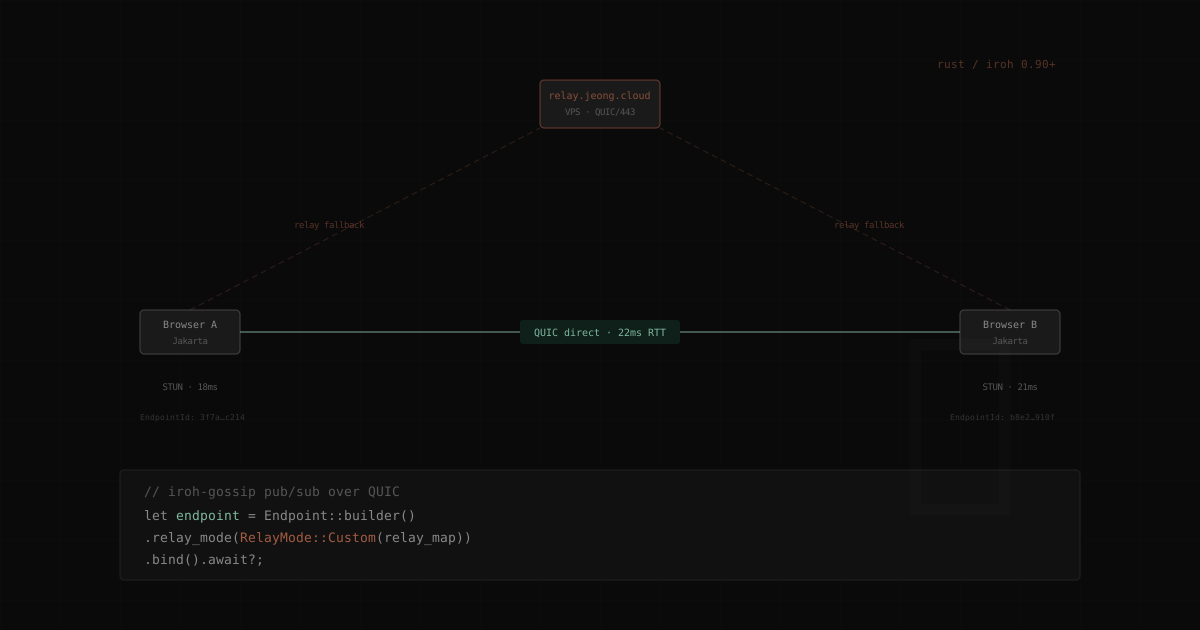
p2p-chat-iroh is a browser-based peer-to-peer chat built on iroh. Two browsers establish a direct QUIC connection — no central message broker. The relay at relay.jeong.cloud is only used for NAT traversal fallback; once peers find each other, all traffic is peer-to-peer.
Stack: Rust backend (iroh + iroh-gossip), Astro + React frontend, WebSocket bridge between the two, Playwright simulation harness.
How It Works
Each peer runs a Rust process with three layers:
iroh::Endpoint — the QUIC transport layer. On startup, the peer generates an ed25519 keypair; the public key becomes its EndpointId. The endpoint attempts a direct QUIC hole-punch first. If NAT blocks it, traffic falls back through relay.jeong.cloud:8843.
iroh-gossip — a pub/sub overlay on top of QUIC. Each chat room maps to a TopicId derived as blake3(room_name). Messages broadcast on a topic reach all current subscribers. No broker, no central topic registry.
ws_bridge — a WebSocket server that bridges the browser to the Rust backend over loopback. On connect, it replays sorted message history (capped at 500 entries), sends a HistoryComplete sentinel, then fans out live messages and network events in a select! loop.
Browser ──WS──► ws_bridge ──mpsc──► ChatHub ──channel──► run_gossip ──QUIC──► peer
Discovery: tickets, not DNS
When a host opens a room, the backend serialises { topic: TopicId, peers: [EndpointAddr] } with postcard, base32-encodes it, and sends it to the UI as a RoomReady event. The joiner pastes the ticket string; the backend deserialises it, loads the host's addresses into a MemoryLookup, and calls gossip.subscribe(topic, bootstrap_peers). No DNS, no phone-home, no registry required for the gossip layer.
Wire protocol
All gossip messages are GossipFrame variants serialised as tagged JSON:
GossipFrame::Chat— carriesfrom,body,ts(unix ms), and a random 16-bytenonceGossipFrame::RoomClosed— sent by the host on leave
The nonce is stored in a per-receiver HashSet<[u8;16]> for deduplication. Gossip may re-deliver frames, especially over the relay path.
Network trace panel
The UI exposes a live trace panel fed by NetworkEvent broadcasts from the backend: peer discovery, path selection (direct vs. relayed), STUN RTTs, candidate gathering. Observable transport state, not black-box latency.
Simulation harness
A Playwright fixture in simulation/ spawns two cargo run --bin chat -- serve processes, navigates Chromium to a side-by-side simulation page, and drives four scenarios: Basic Chat, Ping-Pong (8 alternating messages at 300ms), Broadcast Burst (5 rapid messages, dedup under rate), and Cross-Talk (concurrent sends from both peers). Each scenario verifies delivery, ordering, and deduplication end-to-end against real backends.
Results
- 20–60ms roundtrip on direct connections from Jakarta
- Clean relay fallback when NAT blocks the direct path
- Per-message dedup on a 16-byte nonce handles gossip re-delivery
- History replay for late-joining browser tabs, deterministic ordering by
(ts, nonce)
What I Learned
glibc vs. musl: read the error one layer down
The Docker image for my relay refused to start:
exec: /app/iroh-relay: no such file or directory
The binary was in the image. The file existed. The error was from the dynamic linker — a glibc-linked binary running in an Alpine (musl) container. ldd inside the container made it obvious in seconds. The fix was switching from Alpine to a Debian slim base.
The pattern: when something errors at a layer I don't own, drop down a layer before diagnosing. ldd, strace, file exist for this. I should reach for them earlier rather than searching upward through config I already understand.
Registering a custom relay is not the same as using it
I configured relay.jeong.cloud as the relay, but traffic kept going through n0's Singapore relay. Turns out insert_relay adds to the map — it doesn't remove the defaults. iroh measured RTT to all candidates and picked Singapore because it was actually faster from Jakarta.
The fix was disabling defaults and inserting mine as the only option:
let relay_map = RelayMap::from_nodes([RelayNode {
    url: "https://relay.jeong.cloud".parse()?,
    ..Default::default()
}])?;

let endpoint = Endpoint::builder()
    .relay_mode(RelayMode::Custom(relay_map))
    .bind()
    .await?;
Sensible defaults can quietly compete with whatever you're building on top of them. If the custom thing needs to be used, actively displace the defaults rather than registering alongside them.
When the type checker and a blog post disagree, trust the type checker
iroh crossed a major release while I was building. NodeId became EndpointId. NodeAddr became EndpointAddr. Tickets moved into iroh-base. Most of the example code I was referencing didn't compile against what I had installed.
I burned an hour trying to reconcile old snippets before I closed the browser tabs and let rust-analyzer guide me from the actual installed types. For any crate moving fast, the installed types are the ground truth. Compiler errors are documentation.