The Impulse
I've always been curious about what happens before your code runs — the space between power-on and main(). So on a Friday evening I opened Philipp Oppermann's Writing an OS in Rust and started building.
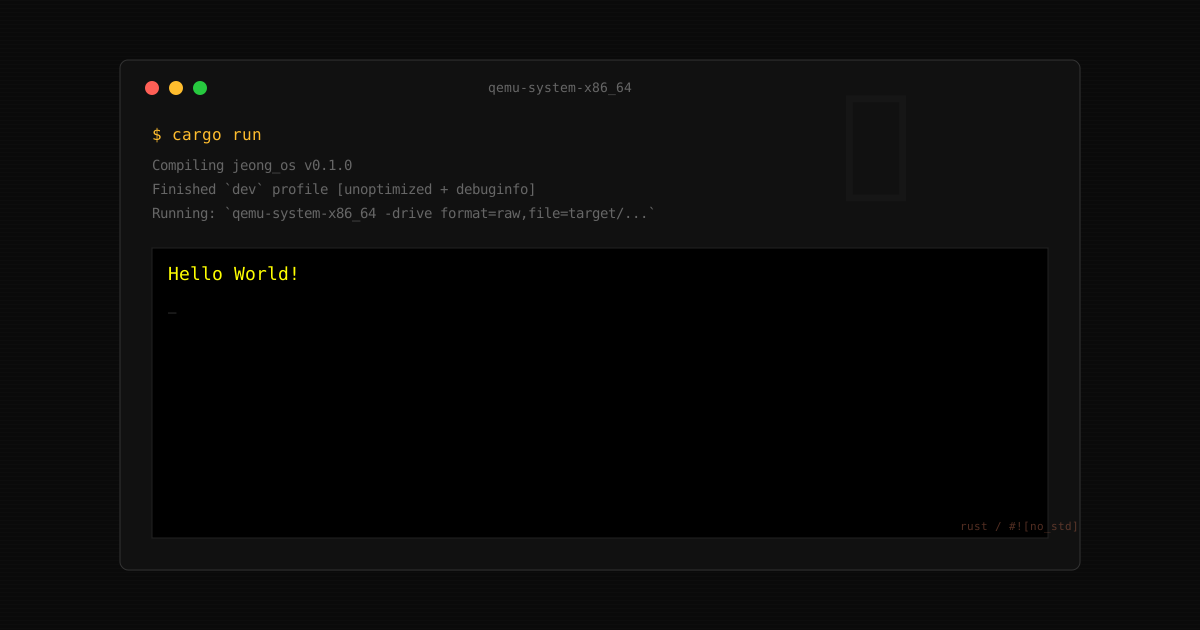
The result is jeong_os — a minimal bare-metal kernel targeting x86_64, written entirely in Rust. No standard library. No operating system underneath. Just a binary that boots in QEMU and prints "Hello World!" in yellow text on a black screen.
No Standard Library, No Safety Net
The first thing you learn when writing a kernel is how much std does for you. println! needs an allocator. Panic handlers need a runtime. Even the entry point main is a lie — it's called by crt0, which is provided by your OS.
A freestanding kernel starts with two attributes that strip all of that away:
#![no_std]
#![no_main]
From here, you're responsible for everything. The entry point is a raw extern "C" function with #[no_mangle] so the linker can find it. The panic handler is a function you write yourself. There's no heap, no threads, no filesystem — just a flat memory space and hardware registers.
Custom Target
Rust's built-in targets assume an operating system exists. A kernel is the operating system, so I needed a custom target specification:
{
    "llvm-target": "x86_64-unknown-none",
    "os": "none",
    "linker-flavor": "ld.lld",
    "panic-strategy": "abort",
    "disable-redzone": true,
    "features": "-mmx,-sse,+soft-float"
}
A few things worth noting:
panic-strategy: abort— No unwinding. When a kernel panics, there's nothing to unwind to.disable-redzone— The red zone is a 128-byte area below the stack pointer that leaf functions can use without adjustingrsp. Hardware interrupts don't respect it, so a kernel must disable it or risk stack corruption.-mmx,-sse,+soft-float— Disable SIMD instructions. The kernel would need to save/restore SIMD state on every interrupt otherwise, which is expensive for code that doesn't need it.
VGA Text Mode
The first visible milestone: writing characters to the screen. In text mode, the VGA buffer lives at physical address 0xb8000 — a 25-row by 80-column grid where each cell is 2 bytes: one for the ASCII character, one for the color.
pub struct Writer {
    column_position: usize,
    color_code: ColorCode,
    buffer: &'static mut Buffer,
}
The Writer tracks the current column, wraps on overflow, and scrolls by shifting all rows up when the screen fills. Each character write goes through Volatile to prevent the compiler from optimizing away writes to memory-mapped hardware.
The color system is a 4-bit foreground + 4-bit background packed into a single byte:
| Color | Value |
|---|---|
| Black | 0 |
| Blue | 1 |
| Green | 2 |
| Cyan | 3 |
| Red | 4 |
| Yellow | 14 |
| White | 15 |
Once the writer existed, I built print! and println! macros on top of it — same interface as standard Rust, but routing through the VGA buffer instead of stdout.
Global Writer with lazy_static
The writer needs to be globally accessible (any part of the kernel might need to print), but Rust doesn't allow mutable statics without unsafe. The solution: lazy_static with a spin::Mutex.
lazy_static! {
    pub static ref WRITER: Mutex<Writer> = Mutex::new(Writer {
        column_position: 0,
        color_code: ColorCode::new(Color::Yellow, Color::Black),
        buffer: unsafe { &mut *(0xb8000 as *mut Buffer) },
    });
}
A spin mutex instead of std::sync::Mutex because there's no OS to provide blocking primitives. The lock just busy-waits — acceptable for a single-core kernel.
Serial Port for Testing
VGA output is visible in QEMU's graphical window, but for automated testing I needed machine-readable output. The UART 16550 serial port at I/O address 0x3F8 writes directly to QEMU's stdio when launched with -serial stdio.
lazy_static! {
    pub static ref SERIAL1: Mutex<SerialPort> = {
        let mut serial_port = unsafe { SerialPort::new(0x3F8) };
        serial_port.init();
        Mutex::new(serial_port)
    };
}
This gave me serial_print! and serial_println! — same pattern as the VGA macros, but output goes to the host terminal instead of the emulated screen.
Custom Test Framework
Rust's default test framework depends on std, so it's unavailable in #![no_std]. Instead, the kernel uses #![feature(custom_test_frameworks)] with a custom runner:
pub fn test_runner(tests: &[&dyn Testable]) {
    serial_println!("Running {} tests", tests.len());
    for test in tests {
        test.run();
    }
    exit_qemu(QemuExitCode::Success);
}
Each test function gets wrapped in a Testable trait that prints the fully-qualified function name before running and [ok] after. If a test panics, the panic handler prints [failed] to serial and exits QEMU with a failure code.
The QEMU exit is done by writing to a special I/O port (0xf4) configured via -device isa-debug-exit:
pub fn exit_qemu(exit_code: QemuExitCode) {
    use x86_64::instructions::port::Port;
    unsafe {
        let mut port = Port::new(0xf4);
        port.write(exit_code as u32);
    }
}
The exit code mapping is intentionally offset (Success = 0x10 maps to host exit code 33) so QEMU's own exit codes don't collide with test results.
What I Learned
Rust is remarkably good at this. The type system catches real bugs — buffer overflows, dangling references, race conditions — at compile time, even without std. The repr(C) and repr(transparent) attributes give exact control over memory layout, which matters when your "API" is a hardware specification.
The abstractions we take for granted are enormous. println! in a normal Rust program is maybe 5 characters of thought. In a kernel, it's a VGA buffer driver, a global mutex, volatile memory writes, color encoding, line wrapping, and screen scrolling.
unsafe is a scalpel, not a sledgehammer. The entire kernel has exactly 3 unsafe blocks: the VGA buffer pointer cast, the serial port initialization, and the QEMU exit port write. Everything else — including the test framework, color system, and print macros — is safe Rust.
What's Next
The "Bare Bones" section is done. The next chapters cover:
- CPU Exceptions — IDT setup, breakpoint/double-fault handlers
- Hardware Interrupts — PIC, keyboard input, timer
- Paging — Virtual memory, page tables, heap allocation
The repo is at github.com/zeon-kun/jeong_os.